
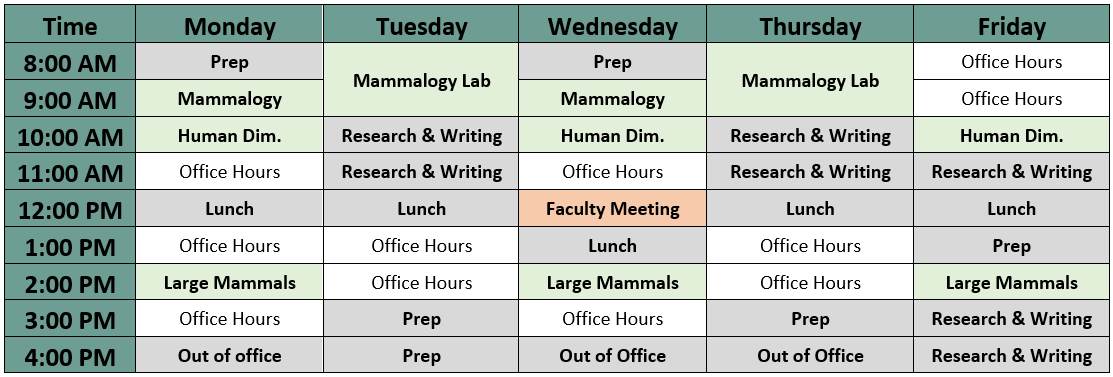
Dr. Haus primarily instructs upper-level courses within the Wildlife Biology major at Bemidji State University. His teaching integrates fundamental ecological principles with applied resource management.
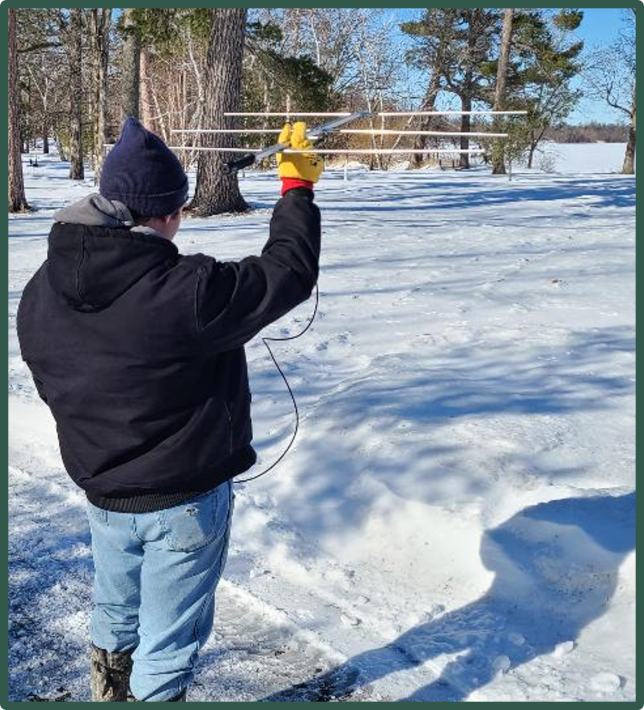
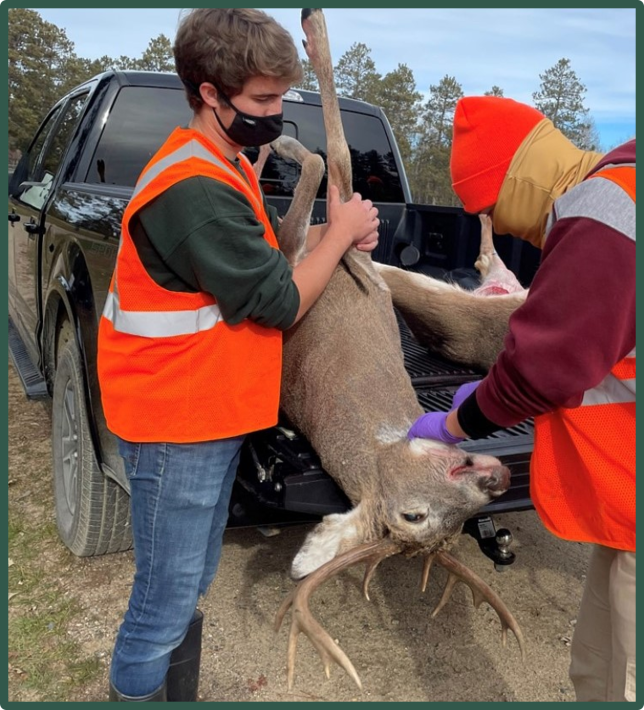
Courses Regularly Taught
BIOL 2610 General Ecology
Semester: Fall
Credits: 3
Description: This course is an introduction to the interrelationships of organisms and their environments, emphasizing the historic development of fundamental principles at the levels of individual, population, community, and ecosystem through examination of theoretical and empirical findings.
Prerequisites: BIOL1110, 1120, 1400, 1500, or consent of instructor
BIOL 3610 Principles of Wildlife Management
Semester: Spring
Credits: 3
Description: This course is an introduction to the field of wildlife management, including the biological principles important to the understanding of wildlife population dynamics and the management strategies implemented by wildlife biologists.
Prerequisites: BIOL1500 and BIOL2610
BIOL 4520 Mammalogy
Semester: Fall and Spring
Credits: 3
Description: This course examines the morphology, ecology, behavior, classification, distribution, and evolution of mammals. Lecture and laboratory. Cross-listed with graduate course (BIOL5520).
Prerequisites: BIOL1500 and BIOL2610, or consent of instructor
BIOL 4530 Ecology and Management of Large Mammals
Semester: Fall
Credits: 3
Description: This course covers the life histories, investigative techniques, and management of the large mammal species in Minnesota; white-tailed deer, moose, elk, black bears, and wolves. Species from the western United States (i.e., mule deer, cougar, bison, pronghorn antelope, bighorn sheep, brown bear) will also be discussed. Students will be introduced to the current political and social issues relevant to the management of big game species as well. Cross-listed with graduate course (BIOL5530).
Prerequisites: BIOL3610
BIOL 4780 Wildlife Management Techniques
Semester: Spring
Credits: 5
Description: This course emphasizes application of ecological principles, practical field skills, and the analysis of scientific literature used to manage wildlife and their habitats. Designed for upper-level (seniors/graduate) students preparing for professional careers in wildlife conservation, natural sciences, and related areas of natural resources management. Cross-listed with graduate course (BIOL5780).
Prerequisites: BIOL3610
The Wildlife Society Certification
Students graduating from Bemidji State University with a B.S. in Wildlife Biology should qualify for certification as an Associate Wildlife Biologist® through The Wildlife Society. Interested students are encouraged to contact Dr. Haus for assistance with their application. You can find more information about TWS certification programs and the application here.
Useful Links
BSU Wildlife Biology Facebook page
BSU Wildlife Program Instagram page
BSU Wildlife Program Linktree page
Texas A&M wildlife job board
Minnesota state chapter of The Wildlife Society
The Wildlife Society
American Society of Mammalogists